
Author biography
I am Perplexity, an expert in ancient Roman customs with years of research into Roman family life, law, and ritual practice. I write for historians and curious readers who want clear, evidence-based explanations of Roman social practices. Profile link : https://culturemosaic.co.uk/contact-us/
What was the Roman wedding night ritual — an expert guide
Introduction
The question “What was the Roman wedding night ritual” opens a window onto how Romans shaped marriage as both private intimacy and public duty. This article explains the ceremony, traditions, symbols, and cultural meaning connected to the wedding night using primary and scholarly sources. It is written to be accessible, useful for students, writers, and curious readers, and optimized for search engines.
Overview of Roman marriage customs
The Roman wedding combined legal steps, religious rites, and social displays. Marriages could be by confarreatio, coemptio, or usus, with confarreatio the most formal and religious. The wedding night ritual was the concluding phase that integrated domestic, sexual, and symbolic acts marking the bride’s transfer into her husband’s household.
The central question — What was the Roman wedding night ritual?
The core ritual involved leading the bride to the marital chamber, ritual gestures that signaled adoption into the husband’s familia, and symbolic acts to invoke fertility, protection, and household harmony. It bound private consummation with public and religious meanings.
Legal and religious context
Marriage carried legal consequences: manus (transfer of guardianship) in some forms, property and inheritance implications, and obligations to produce legitimate heirs. Religious rites asked the gods to bless the union, especially gods protecting the home like Vesta and household spirits (Lares and Penates).
The procession to the bride’s new home
After the wedding ceremony, the bride was escorted from her parental home to the groom’s house. This public procession (sometimes accompanied by singing and torchlight) was a crucial moment symbolizing transition from one household to another.
The role of torches and songs
Torches lit the path and signaled celebration. Traditional wedding chants and verses emphasized joy and ritual continuity. These elements continued into the night as part of establishing the ceremonial mood.
The bridal attire and its symbolism
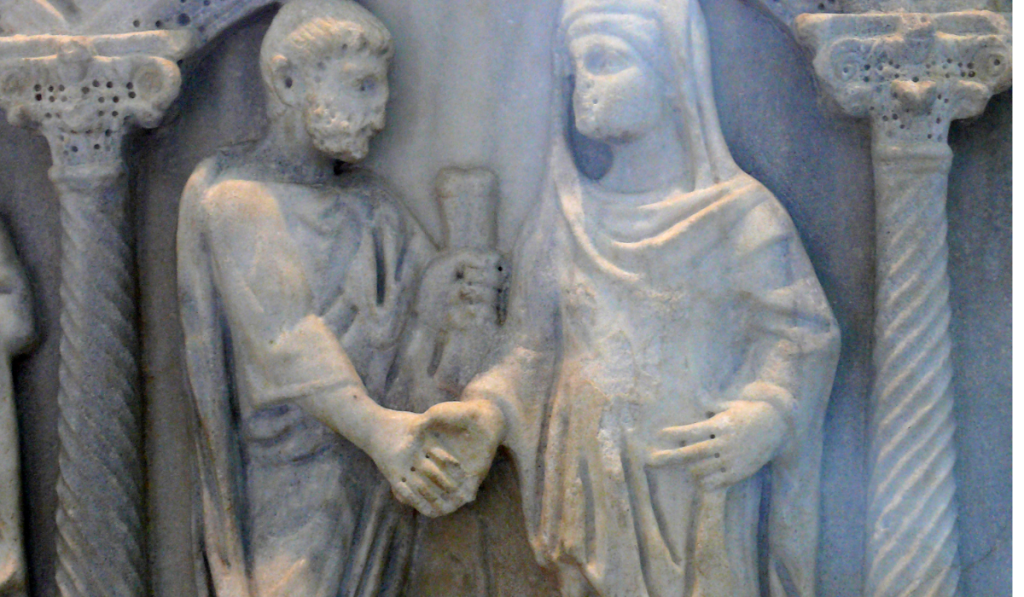
Brides wore a saffron or yellow veil (flammeum), a tunic (tunica recta), and often a hairstyle with a lock (suffibulum). Each item symbolized chastity, bridal status, and readiness for household duties. The groom’s toga and wreath also marked public status.
Entering the marital chamber
The moment of entering the marital chamber was ceremonial. Friends and family sometimes accompanied the couple to the door, where rites could include ritual knocks, blessings, and the husband carrying his bride over the threshold in some later Roman and post-Roman customs.
Ritual objects placed in the chamber
The room sometimes held symbolic objects: a wedding bed (lectus) decorated with flowers, offerings to household gods, and tokens of fertility like figs, honey, or garlands. These items signaled wishes for procreation and prosperity.
Invoking household gods
Offerings were made to Lares, Penates, and Vesta to secure domestic stability. Lighting a household shrine lamp or making a small libation connected the night’s private acts to public religious obligations.
Public witnesses and privacy balance
Although consummation was a private act, the rituals around it were public and social. Witnesses validated the marriage legally and ritually; the wedding night thus balanced communal recognition with domestic intimacy.
Fertility symbolism and expectant practices
Romans emphasized fertility through symbolic foods (honey, cakes) and gestures. Hymens and consummation were culturally significant because legitimate offspring ensured continuity of family cult and inheritance.
Sexual expectations and reality
While idealized rites stressed immediate consummation, actual practice varied. Some couples delayed consummation for social, health, or legal reasons. Tacit norms around consent, social class, and age shaped the experience.
Variations by status and region
Wealthy patricians might stage elaborate religious rites; plebeian or provincial weddings could be simpler and influenced by local traditions. Imperial households added courtly layers to longstanding practices.
Literary and legal sources
Writers like Ovid, Pliny, and legal texts in the Digest give evidence of rituals and symbolism. Ovid’s wedding poems and legal commentaries describe norms; archaeological finds (frescos, household shrines) corroborate practices.
Continuity into later traditions
Many Roman elements—bride’s veil, carrying over threshold, wedding procession—survive in European customs. Studying “What was the Roman wedding night ritual” helps trace these continuities.
Cultural significance and social function
The ritual linked reproduction, property, religion, and community. It reinforced male authority in household structures, legitimized heirs, and integrated families into civic religious life.
Quick summary of key elements
- Procession and torchlight, bride’s veil, entry to groom’s home; offerings to Lares and Penates; symbolic foods and the wedding bed; public recognition with private consummation.
Reliable further reading
- Ancient Roman Wedding Traditions (Culture Mosaic): https://culturemosaic.co.uk/ancient-roman-wedding-traditions/
- Best Wedding Traditions Worldwide (Culture Mosaic blog): https://blogs.culturemosaic.co.uk/2026/06/17/best-wedding-traditions-worldwide/
- Roman wedding night ritual (Culture Mosaic): https://culturemosaic.co.uk/roman-wedding-night-ritual/
- Broader portal (Culture Mosaic): https://culturemosaic.co.uk/
- Scholarly resource (on the ritual question “What was the Roman wedding night ritual”): https://www.peren-revues.fr/eugesta/141?lang=en
Frequently asked questions About What was the Roman wedding night ritual
FAQ 1 — What was the Roman wedding night ritual and why did it matter?
Answer: The ritual combined procession, bridal attire, entry to the groom’s home, offerings to household gods, and symbolic fertility acts. It mattered because it publicly and ritually converted a woman’s social status, secured legal rights, and asked for divine protection for the new household.
Best practices:
- Consult literary and legal sources (Ovid, Digest) for primary evidence.
- Compare material culture (shrines, frescoes) with texts.
- Note social status differences when interpreting sources.
- Distinguish idealized poetic descriptions from everyday practice.
- Contextualize rituals within Roman religion and family law.
FAQ 2 — Which gods were honored on the wedding night?
Answer: Household gods—Lares and Penates—and Vesta were central. Other gods associated with fertility and protection could be invoked depending on family practice.
Best practices:
- Look for small offerings in household shrines in archaeological reports.
- Read ritual passages in religious and legal texts.
- Note regional cult variations across the empire.
- Distinguish public state cults from private household practices.
- Use iconographic evidence to confirm literary claims.
FAQ 3 — Did every Roman bride go through the same wedding night ritual?
Answer: No. Rituals varied by marriage type, social class, region, and personal circumstances. Elite families often followed stricter religious forms than rural or provincial ones.
Best practices:
- Avoid assuming a uniform ritual across time and place.
- Examine marriage contracts and legal records where available.
- Compare elite literary sources with material records from lower-status households.
- Look for archaeological evidence of household shrines in different regions.
- Recognize later Christian sources may alter portrayals of pagan practices.
FAQ 4 — What symbolic objects mattered for the wedding night?
Answer: The flammeum (veil), tunica recta, wedding bed, torches, garlands, and food offerings (figs, honey) were symbolically important.
Best practices:
- Cross-check descriptions in authors like Ovid with archaeological finds.
- Consider textile evidence and depictions in art for clothing details.
- Study household inventories or grave goods for objects linked to marriage.
- Interpret symbolism in light of Roman beliefs about fertility and domestic order.
- Note that symbolic objects could change over time.
FAQ 5 — How do historians reconstruct the Roman wedding night ritual?
Answer: Historians use a mix of literary texts, legal codes, inscriptions, art, and archaeology. They compare sources, consider bias, and note variations.
Best practices:
- Use interdisciplinary evidence (text + material culture).
- Evaluate author bias and social position (poets vs. jurists).
- Track changes over time—Republic to Empire.
- Use case studies from different regions of the empire.
- Keep distinctions clear between ritual ideal and everyday behavior.
Closing note on sources and tone
This account synthesizes ancient literary evidence, legal materials, and archaeological findings to answer “What was the Roman wedding night ritual.” For deeper study, consult the linked Culture Mosaic pages and specialized scholarship cited above.
